Everything has been going well with the renovations, but as anyone who has had renovations will attest, it’s unheard of to go through to completion without a hiccup. This renovation is no exception. We’ve hit our first hiccup, in fact we’ve hit two.
Fingers crossed that the two little hiccups stay small. We had the flooring booked to be laid this coming Monday and Tuesday. I phoned yesterday to confirm that only two days would be needed. However it seems the ordered flooring has gone astray. A week ago when the arrangements were made, the flooring had, supposedly, just arrived into store. Yesterday I phoned to confirm the days needed would be only two, only to be advised the flooring had disappeared. Tracking indicates it left Melbourne and it arrived into the Perth warehouse. From there it should have been transported to Busselton. It’s not there. Tomorrow the Perth warehouse is going to have a thorough search. I hope it turns up, but it’s not sounding promising.
The electrician was coming today to complete all the electrical work. It was around 11 when he called in on his way to the hospital to get x-rays on an elbow that’s been giving him grief. He hoped to get back later. Fortunately for him (and for us) nothing was broken, so he did make it back, but with half the day gone of course there wasn’t time to finish everything. His hope is to be able to come back Monday, and possibly Tuesday of next week to complete the wiring. However, he informed us, that also may not be possible. He has an appointment in Perth on Friday at the eye department of one of our major hospitals, and it’s possible he may have to undergo a vitrectomy. If so, it’s possible he will be out of action for a short while.
We decided the best thing to do is to postpone the floor in the hopes that the electrician is able to make it back to finish the job (I’m sure he’s hoping he’s not going to need any eye surgery, as are we). We had been hoping to get the ceiling, and the remainder of the walls painted before the flooring went down anyway, and the ceiling can’t be painted until the lights, and fan etc have been fitted. So the floor has been postponed for a week. That should give us time to get the wardrobes completed, the barn door attached to the bathroom, the cornice up, and all the painting complete. I hope the flooring turns up.
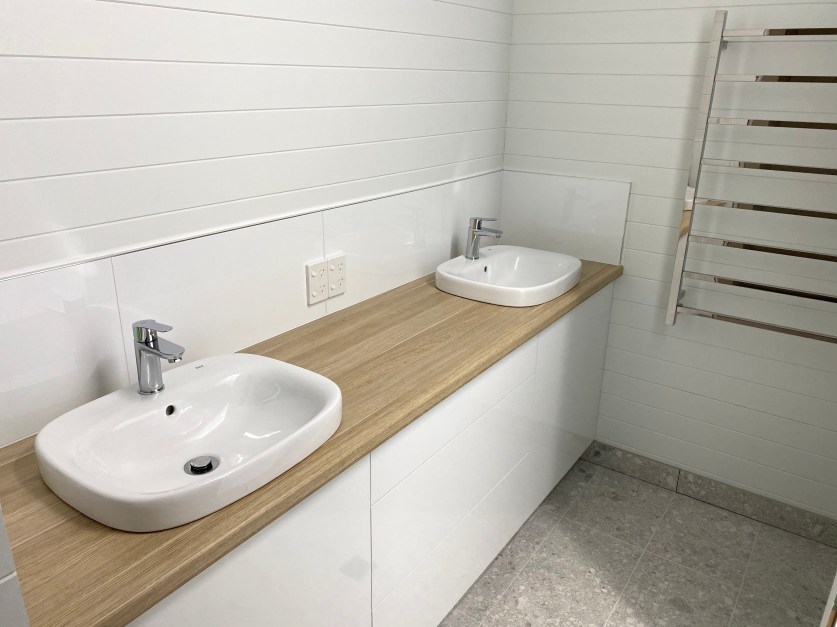
In the meantime, here’s a sneaky peak at the progress….
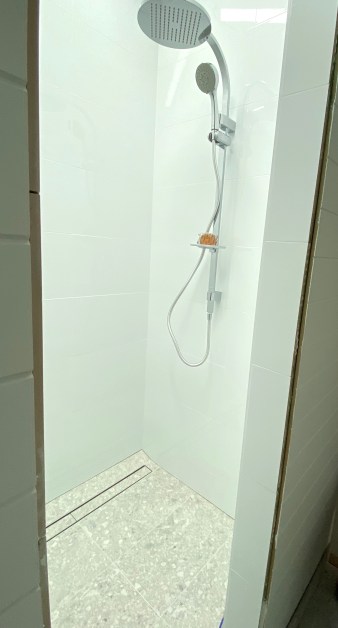
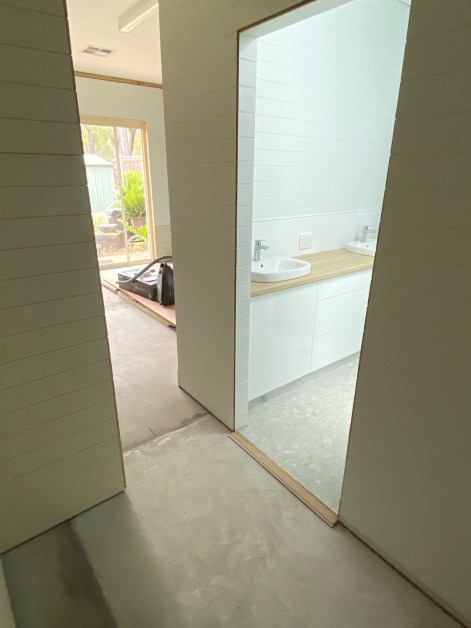
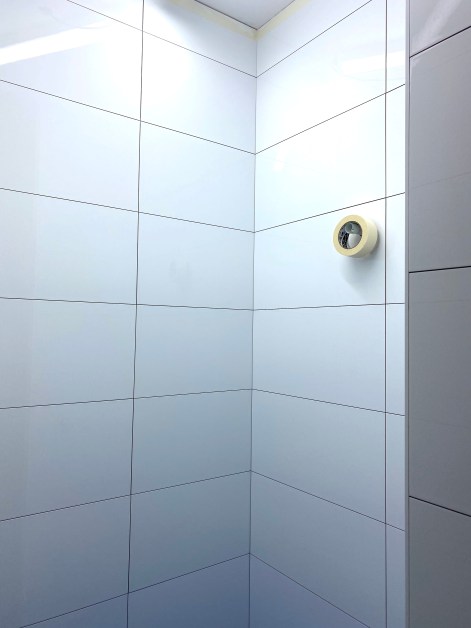
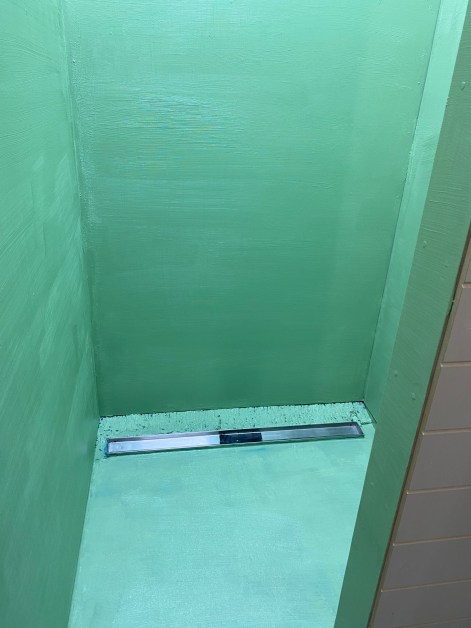
Mirrors and wiring still required (shower looks smaller than it is – have you ever tried to photograph a shower recess!)
Our toilet has also been fitted, but I’m sure you don’t want to see a photo of the toilet. It’s a rimless toilet, which I’d never heard of. I like the idea of that!
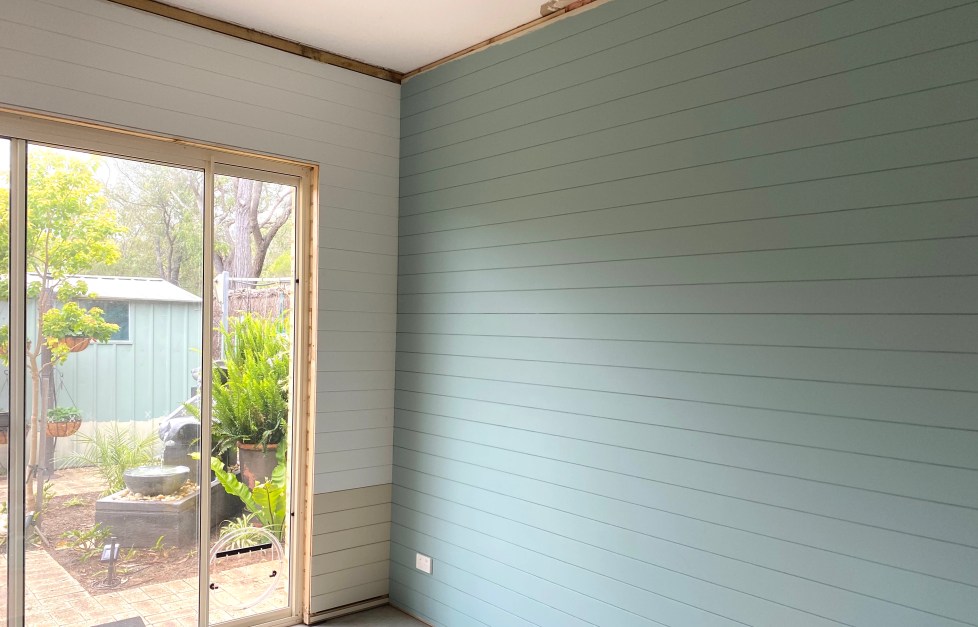
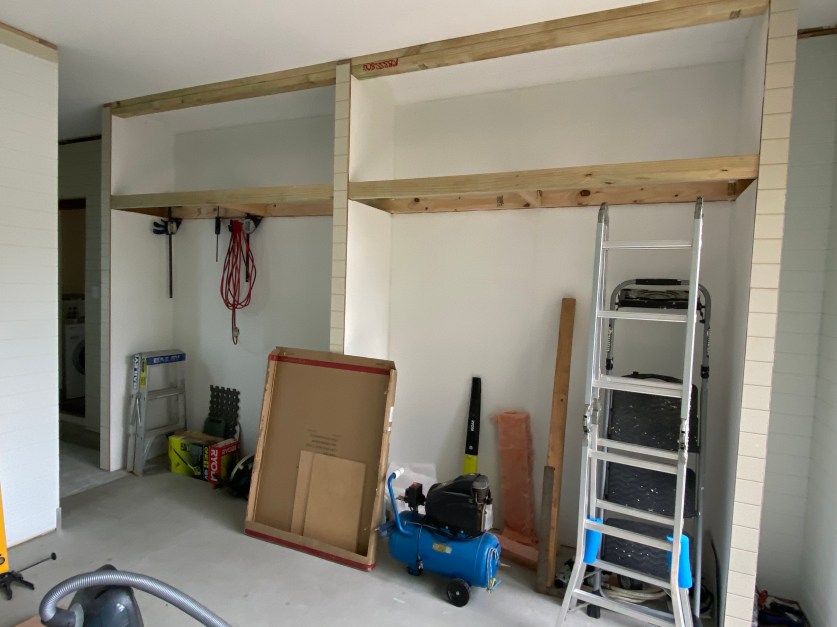
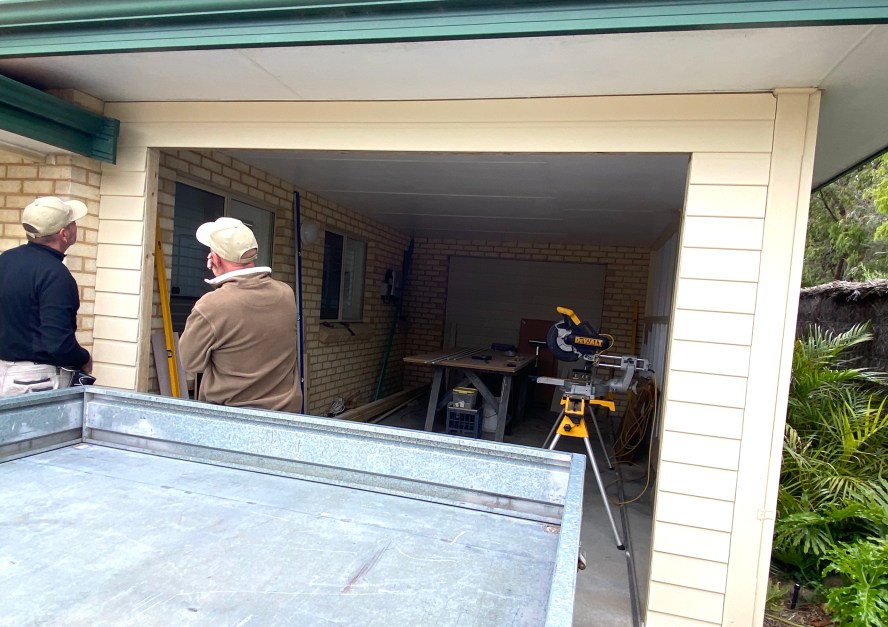
The feature wall painted duck egg blue, the adjoining walls are icy white (not yet completed)The start of the wardrobes. The doors will be made with vertical panelling for contrast.The guys checking out the work thus far on the garage. We’re converting the carport to a garage. It used to be a garage, with a carport in front. Our kitchen and one dining room window opens into the carport, and if we block in the windows the room will become a bit to dark. We’ve decided to keep the windows, and opaque panels have been fitted on the sidewall of the garage, plus the sectional door will be opaque. That should still allow the natural light to filter in. We’ll have to be strict about keeping the garage tidy! I’m not sure if the plan will be clear from this photo. We enter the bedroom off the laundry, which used to open into a single garage. A double garage would have given us a good amount of space which would have allowed for a good sized walk in robe, a bigger room, and a good sized bathroom. But we only had single garage space to work with, so have optimised the space (we think) in the best way possible. The laundry will, in time, be changed to a European laundry giving it a corridor effect. We’ve created a private, little hallway that leads to bedroom area, and the bathroom is off the hallway. Not having the bathroom entrance directly off the bedroom maximises the useable space in the bedroom. We’ve forfeited the walk in robe and have opted instead for two, good sized floor to ceiling fitted robes. Forfeiting the walk in robe meant we could have a reasonable sized bathroom with a good sized shower (1200 x 1200). We’ve also decided the room will be more spacious if we keep things minimalistic. The wardrobes should provide enough storage so as not to need a dressing table.
So that’s today’s progress report – providing the hiccups remain small, the completed project won’t be far away. Watch this space….
It’s a wonderful time in our garden at the moment. The lawn is growing vigorously and needs cutting at least weekly. There’s nothing quite like the smell of new mown grass. The deciduous trees are re-clocked with their new leaves, and the flowers are blooming. The perfume wafting around in the breeze is delightful.
The jasmine is in full bud, all just starting to open
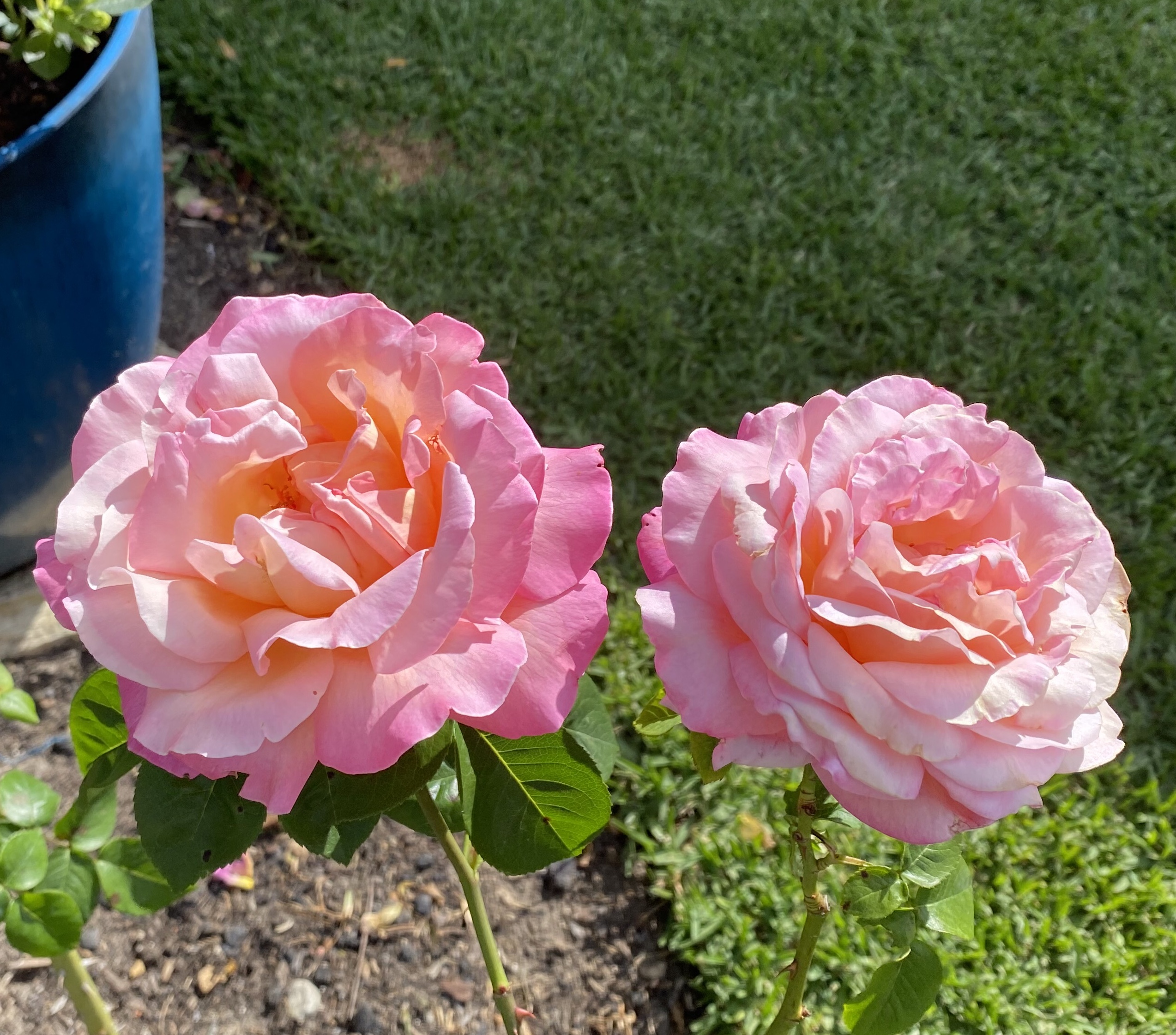
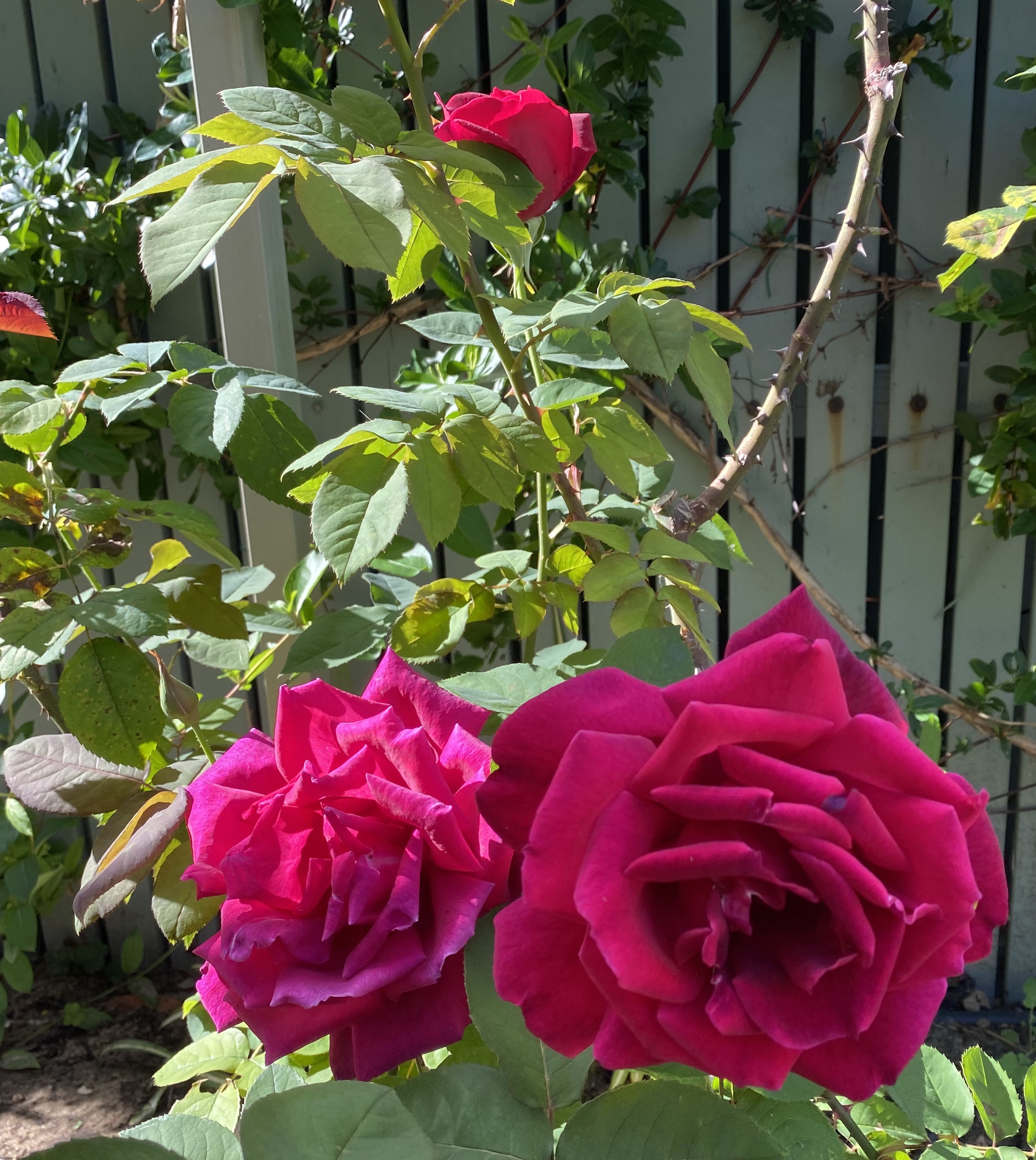
The roses are blooming
The honeysuckle is coming into full flower
Fragrant lemons mingle with the powerful scent of citrus blossom heralding more fruit to come
And our favourite garden perfume comes from our elephants ears. If you try to smell the flower up close, it appears to be almost odourless, but at certain times of day an almost elusive, delightful, floral scent carries on the breeze and permeates the surrounding area. It took us a long time to pinpoint where the sweet scent was coming from. Now we can’t wait for the rather plain flower spikes to appear between the large, glossy leaves, knowing that our noses are in for the most amazing sensory delight.
So that’s our garden in November. For December we have more beautiful perfumes to follow. Our three frangipani trees are just starting to come into leaf, so the gorgeous, sweet smelling, cream and yellow flowers will soon be here too. Gardening has always been a labour of love for me, the colour, the produce, and the perfumes. The garden is surely life’s simplest of pleasures!
The framework is up for the bottom part of the garage wall. Paul painted it yesterday, and applied a second top coat today.
The carport is being converted to garage.
We’ve received one quote for a garage door, but will get another one or two quotes before we decide who will get our business for that. The bottom part of the garage wall, where the framework is, will be solid, the top half will be done in opaque, as will the garage door.
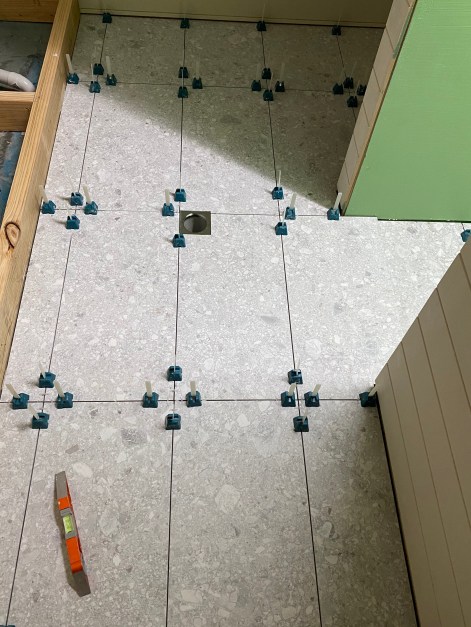
The bathroom floor, and the shower walls have been tiled, and should be grouted on Monday.
shower walls awaiting the grout, and the shower of course.
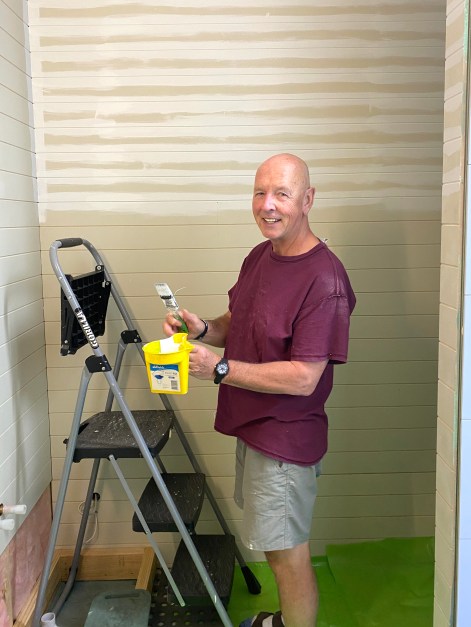
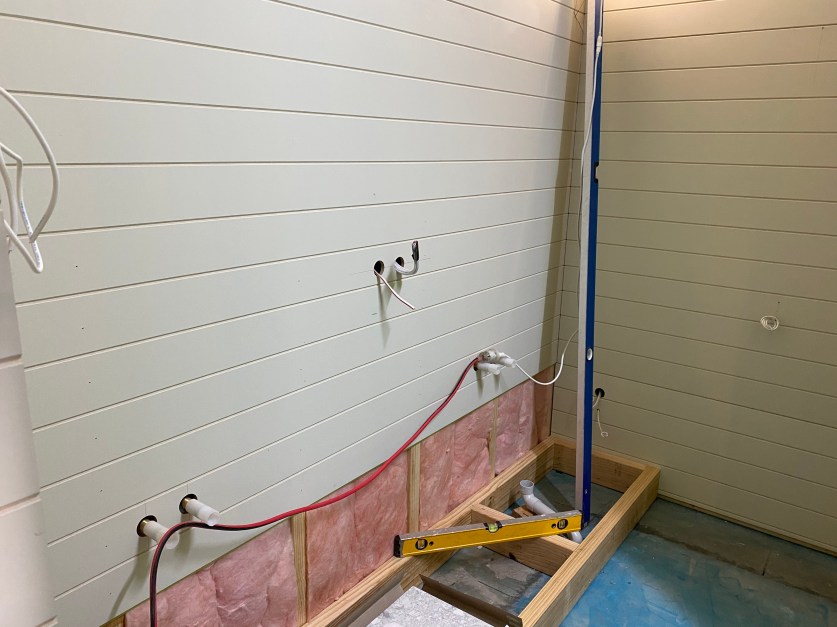
The panelling is up on the other bathroom walls too. Paul is painting them this week-end in readiness for the bathroom fixtures to be fitted some time next week. Mmmm, he’s not enamoured with my/our choice of wall at the moment! The boards come primed and ready for the top coat of paint. Unfortunately, all those groves between the panels need the top coat to be cut in with a paint brush – never thought of that when I suggested panelling instead of ordinary gyprock. After the cutting in is completed the rest of the painting can be done with a roller. A day to do the cutting in, half an hour to do the full wall with a roller.
The happy painter This wall will also be done in the panelling – yikes, the painting – what a job that’s going to be.
The longer panels needed for the bedroom are due to arrive on Monday. Hopefully they’ll be fitted Tuesday. We’re guessing the end of next week should see the bedroom and bathroom really close to completion, and we should be able to work out by then when the flooring and curtains will be able to be fitted.
Our premier has announced a relaxing of our hard border controls is to take effect on 14th November. We will then be able to travel between all states and territories with the exception of NSW and Victoria, without the requirement for self isolation upon our return. The new freedom comes with a warning – should the virus re-appear Mark McGowan, our premier, will have no hesitation in putting us back into lock down.
We’ve booked tickets to Darwin for a two week holiday in January/February. Our son and daughter-in-law have moved from Katherine to Darwin, so we’re going up to see them, and we’ll get to see Darwin in the wet season. I love a really good storm, but my son tells me I’ll hate the humidity. He’s probably right, but hey – I’ll never ever know, if I never, ever go.
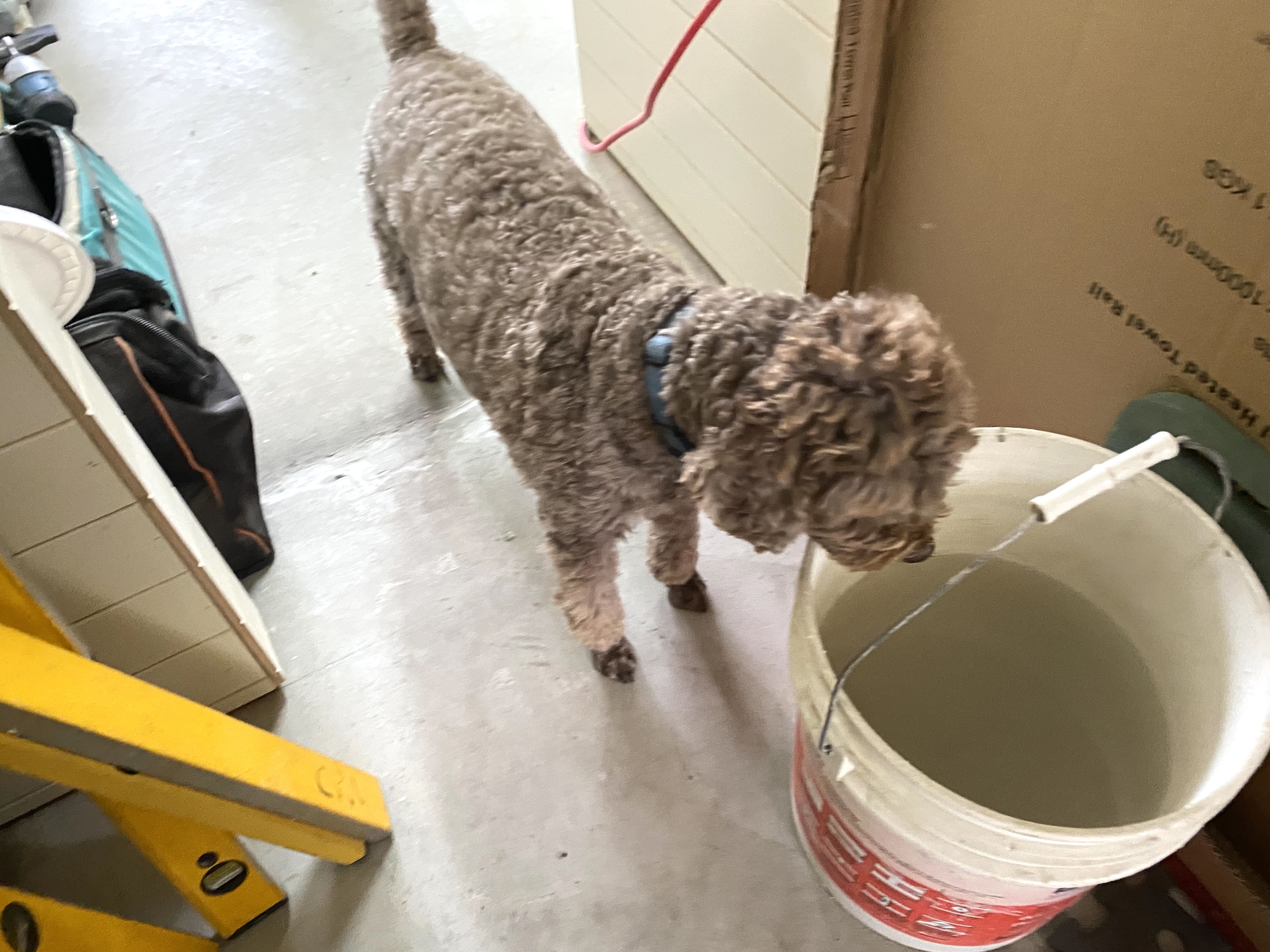
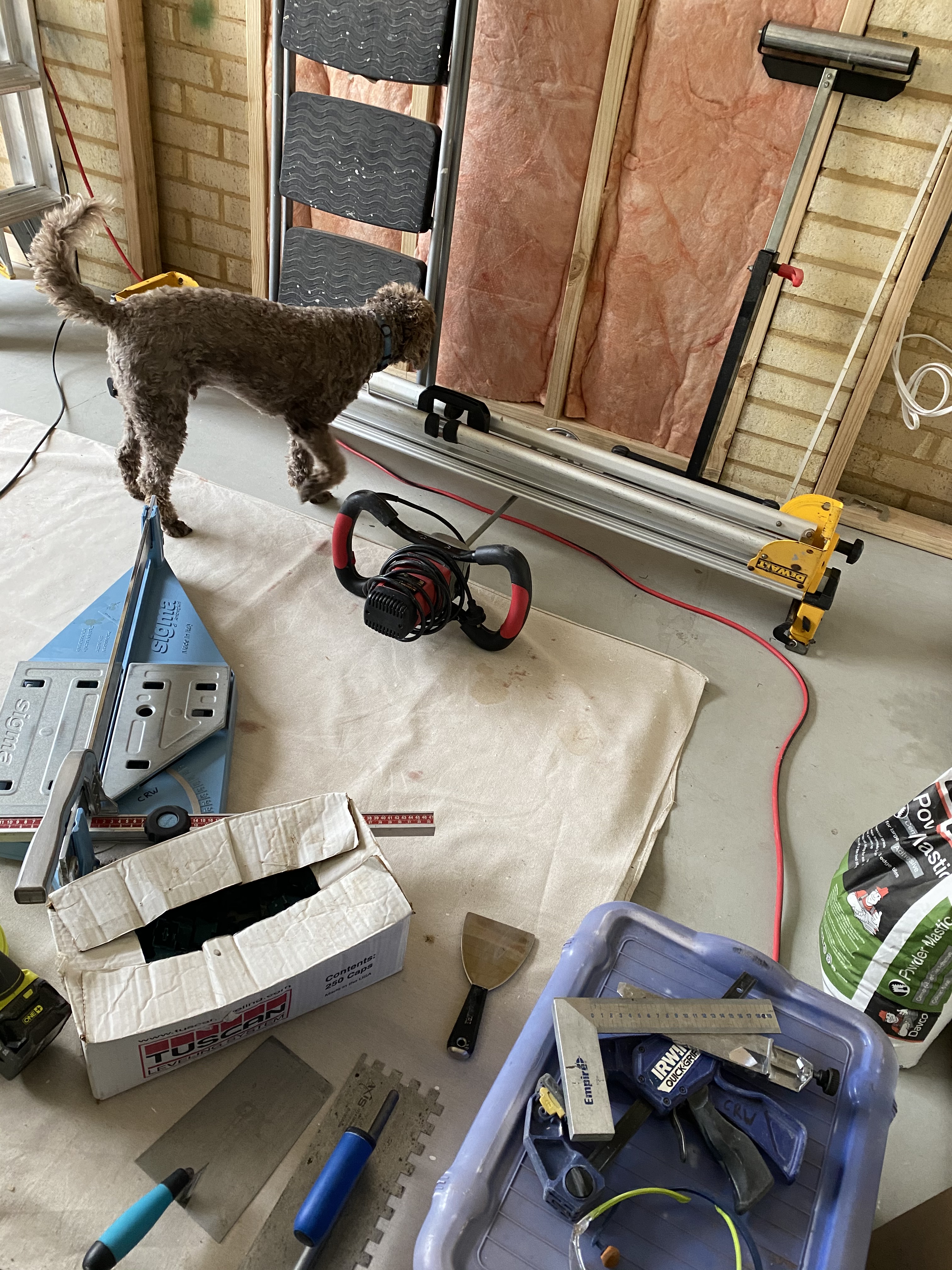
Colin, the builder, has finished for the day. Paul has lugged all the equipment from the carport back into the half finished room for safe keeping. The make shift heavy cardboard door has been screwed into place. Time now for the building inspector to do his nightly inspection.
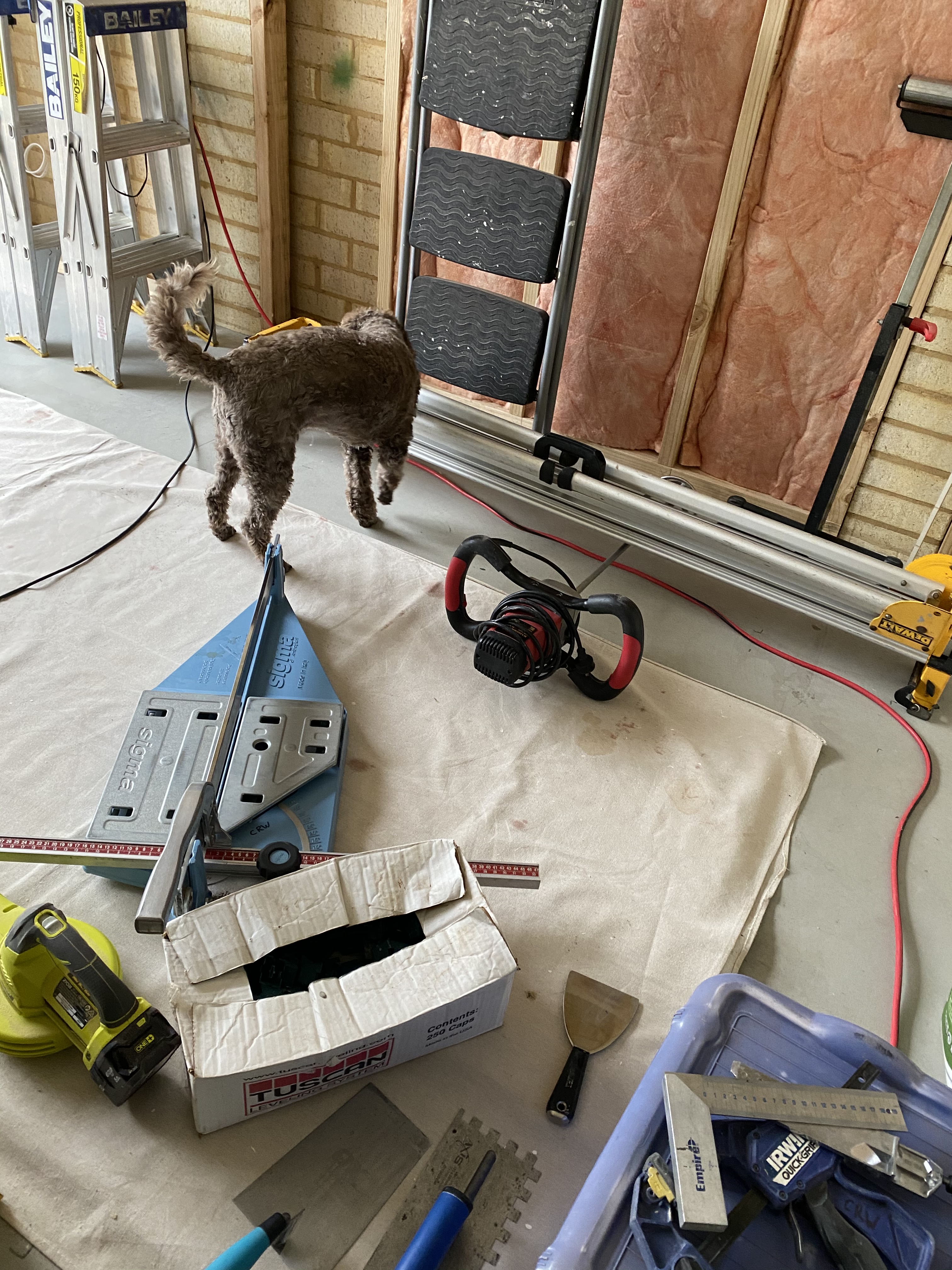
Every piece of equipment is looked over and sniffed. Anything that was there yesterday gets just a cursory glance, but he takes his time with anything newly added. The tile cutter was new tonight, he spent a few minutes sniffing every inch of that.
Today’s work though was sealed off from his prying eyes as the adhesive is still soft, and the spacers are still in place. Another surprise for him to expect tomorrow night.
Floor tiles have been laid.
I think by the end of this week it’s going to be really taking shape.
Work on the new bedroom and en-suite is well underway. The en-suite is taking shape with the shower walls up, some of the bathroom wall panelling fitted, and the pre-plumbing fit out completed. Paul spent much of today applying the green water proof coating to the shower walls and floor. The floor tiles will be laid tomorrow, and the shower wall tiles the following day. The vanity cabinet has been ordered with delivery expected next week.
All waterproofed and ready for the tilesThe pre- plumbing fit out is complete, and the kick boards of the double vanity is in place
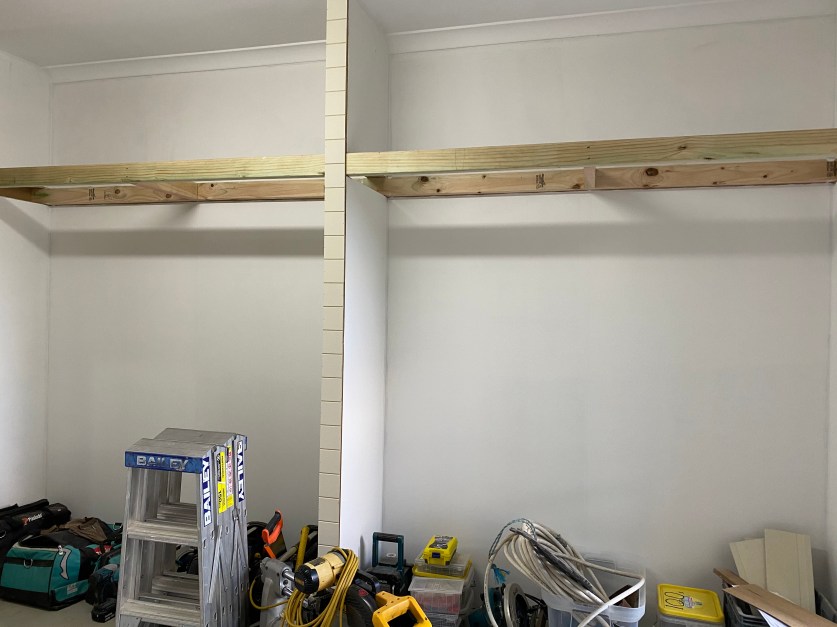
The wardrobe framework is up. Unfortunately we couldn’t fit in a good sized walk in robe, so have opted instead for two floor to ceiling fitted robes. Each robe is bigger than the one we have in our current bedroom. We’re waiting for the hardware for the sliding doors, and for the panelling to make the doors. Paul undercoated the rear of the wardrobes on the week-end.
The wall panelling comes in various sizes up to 4.5 metres in length, only the 4.5 metres sheets weren’t readily available in WA. They‘ve been ordered from the Eastern states, and are due to arrive on Monday of next week. The guys have gone ahead with the shorter walls using the lengths of the panelling that were available locally. The plan is to have an eclectic/coastal themed room with horizontal panelling on the walls to both bedroom and bathroom. The wardrobe doors, and the ranch style, sliding door to the bathroom will be made with the same panelling, only it’ll be vertical.
Some of the acoustic insulation is in the longer wall awaiting the arrival of the bigger panelling.
As the wall hasn’t as yet been built where the roller door was removed from, the work site is out of bounds to a Mr Tilly during the working hours. It’s all open to the street, and he’s still to impulsive to be allowed near roads. At the end of the day Paul puts a make shift, hard cardboard wall up to secure the room from passers by, and it’s then that Mr Tilly gets to take a look. He inspects the room, seemingly aware of what has been achieved that day. He goes into the bathroom first, then into the bedroom carefully perusing every inch of the room. Mr Tilly doing his daily check on the days work
It won’t be long now. The flooring and the curtains have been ordered, and we’re hoping the flooring will be going down during the second or third week in November, with the curtains a few days later. We’ll be wanting to get all the painting done prior to the flooring of course, so there’s still a lot to do. When it’s all finished I’m sure Paul is going to be looking forward to a good rest. Perhaps I’ll let him have a nice sleep in, in the new bedroom.
I’ve been reading one of the most refreshing blogs lately, the blog of M.R. stringer. margaretrosestringer.com (I don’t know why, but when I copy a link to someone’s blog it never seems to create a hyper link, so you may need to do a google search. I’m sure you’ll enjoy her refreshing, no bullshit way of writing as much as I do.)
If you want a laugh with an old lady who calls a spade a spade in the most direct possible way, you’ll enjoy some of Margaret’s writings. Currently M.R. is facing a dilemma. It appears she’s happily been living a vegetarian life style, eating lots of beans and lentils, with her one reported side effect being that these protein sources cause ‘lots of farting’, (M.R. definitely says it as it is). Only it seems there has been another undesirable possible side effect. Diabetes may be looming. I gather a high fat, low carb diet (I think Keto) has been recommended.
A few decades ago the in vogue radical diet of the day was Pritikin – do you remember that one. Virtually no fats at all, low protein and lots of high fibrous carbs (lots of farting I’m sure with that diet). I knew a dedicated follower of the diet at the time. He was slim and gaunt looking with dry, saggy skin. He didn’t look healthy at all. That diet went out of vogue, but a similar, slightly moderated version, the Aitkins diet, seems to have hung around. Some think it was these high carb diets that caused the high prevalence of the muffin top figure to emerge. You know the figure type, a waist the same size as ones hips, only soft with a tendency to spill over one’s waistband.
The Pritikin pyramid
The latest radical diet doing the rounds is the Keto diet. Exactly the opposite of Pritikin – high fat, high protein, and almost no carbs. The mind boggles – how could all of those dietitians and experts have got it so wrong!
Eggs were good for us for centuries, then cholesterol become the buzz word (still is). Eggs became taboo, then only egg yolks became taboo, it seems we could eat the whites, now we can eat whole eggs again. What was that all about! Liver, prawns, nuts, butter, dripping and lard all went by the wayside along with the eggs. Now seemingly, if we start consuming all those taboo foods, and in big quantities we’re going to be on the road to living a long and healthy life.
We’ve seen the Israeli diet, the grapefruit diet, the 5/2 and the 18/6 fasting diets, the CSIRO diet, the Mediterranean diet, and countless other diets come, and mostly go. The Mediterranean diet seems to have stuck around a while and seems to be one that most experts seem to agree is a healthy way of eating. I’ve looked at the Mediterranean diet, and I think another name for it is just a ‘good sense diet’, good honest food that will lend itself to any cuisine you desire to cook. A bit of everything, lots of veges, fruits, whole grains and healthy fats, a good quantity of seafood and fish, and some meat, dairy, and eggs. Why does that have to be given a name as if it’s a prescription.
The Mediterranean diet pyramid
I wonder what the populace of Central Africa would think of their diet selective, western counterparts, not much I suspect!
I don’t think there’s an end in sight to the comings and goings of these so called healthy eating plans in our affluent western world My thoughts are that those of us with expanding waistlines, and diseases such as type two diabetes that accompany the oversized girth (definitely me included, not the diabetes, but certainly the expanding girth) are merely victims of living a lifetime in a part of the world that offers plenty. I’m not sure if there’s been a generation before this current generation that hasn’t seen food shortages, I think we may be the first. We’re so used to having an abundance of food that when the possibility of shortages loomed earlier this year, what did we choose to buy – toilet paper! That’s how sure we are in our sub-conscious minds that an abundance of food will always be there for us. I’m sure the only thing that will stop the food fads and the bazaar elimination of whole food groups from our diets is for the western world to be hit by a famine, or another Great Depression. With the havoc this damned virus is wreaking in the northern hemisphere that may not be as far away as we think. Me thinks it’s time to stock the pantry with some more cans of beans and packets of lentils. There may be a time in the not to distance future when the fat around our girth, and the beans and lentils that we ‘doomsday preppers’ hoarded away are the only things that stand between starvation and survival.
To conclude I’m going to refer to something else I read recently. You can choose how long you want to live (no guarantees), or you can choose how you want to live. For me, I love my food, all of it. I eat a completely balanced diet. equal quantities of healthy, Mediterranean type foods, and on the other side of the scales, cakes, and pastries, and all the other bad for me crap that tastes wonderful. I figure without any unforeseen misfortunes intervening I’m likely to be around till I’m around 80. If I’m still around after that I’ll likely be a decrepit, doddering old git. At this point in my life I’m thinking 80 will do me. Whether I get to 79 and start to think, ‘I want more – could have, would have, should have done better’. Well that remains to be seen, but definitely for now I choose to live life on my terms, eating the foods I love. Food is one of life’s great pleasures, and Im going to enjoy it without guilt, all of it.
PS – I’m still not happy with the inconsistencies of WordPress – the photos above were put in, in exactly the same way, yet one is narrow and slim, the other two full sized. But I am enjoying the freedom of not trying to fit my own blog into a particular theme, and the freedom of just writing about whatever inspires me to write. I’m loving being able to create a diary of me, and for me, my thoughts and my life, without consideration as to whether or not my writings are pleasing to people following along.
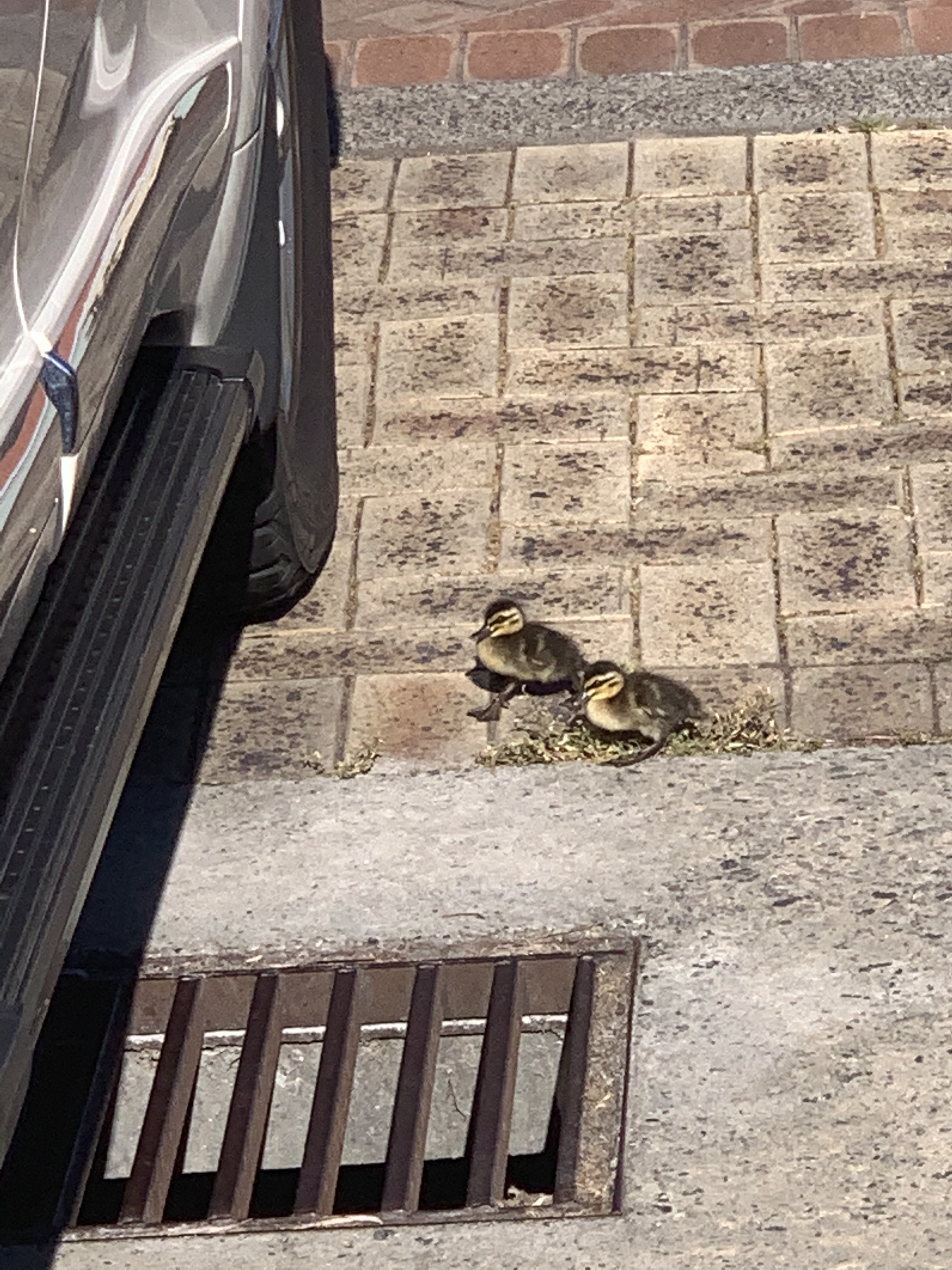
The guys were busy in the carport cutting planks for the renovations when they become distracted by a mother duck and her two fluffy little ducklings. They were running backwards and forwards under Colin’s car, looking cute as hell, but worrying the hell out of us in case one of the little ducklings should slip through the storm water drain under the car. Unfortunately, (or actually in this case, fortunately), one of the two did just that – plop and she was gone.
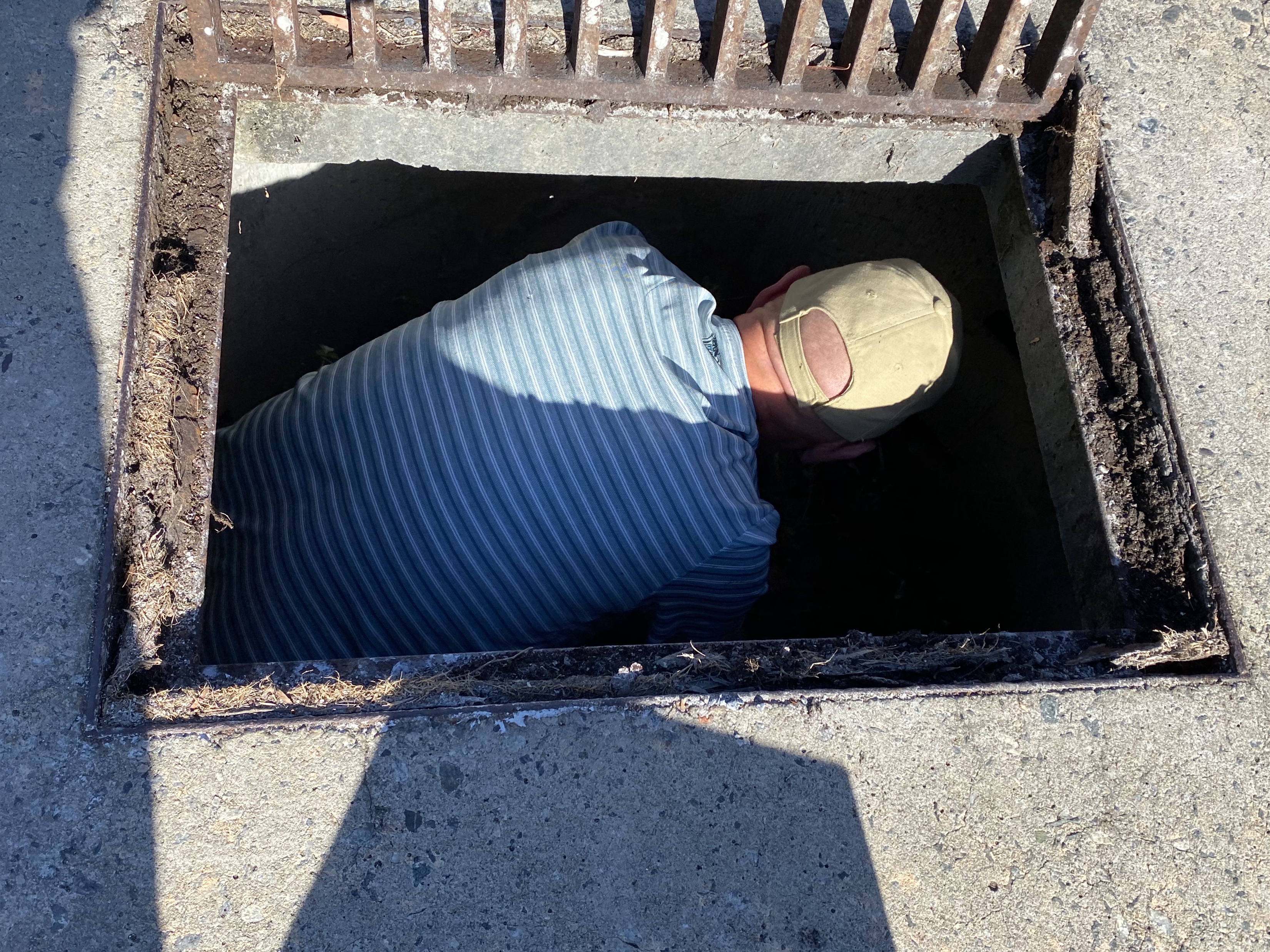
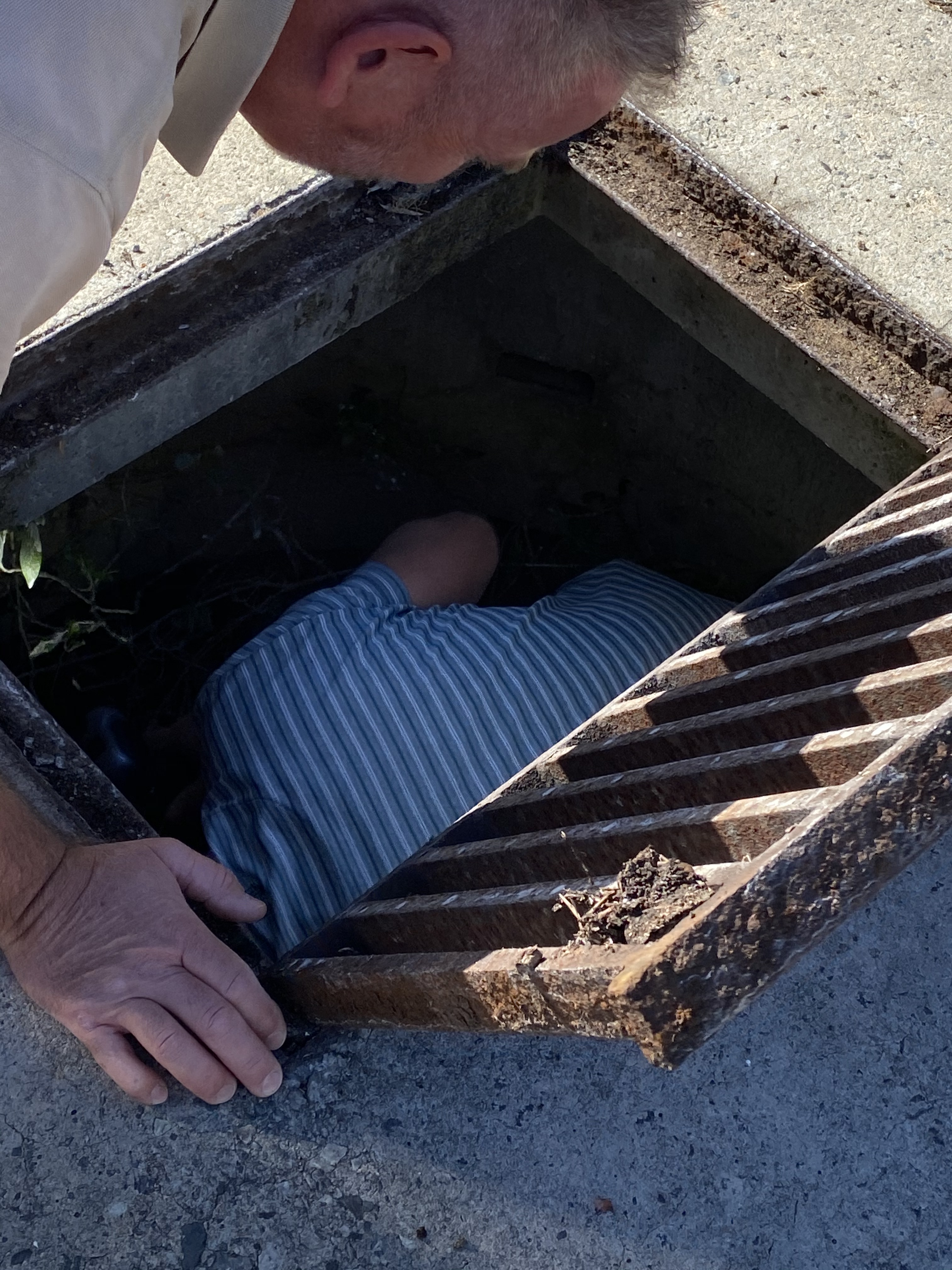
The hole is about a metre deep, and well cushioned with debris and soft sand. The little baby was cheeping away calling for mum, and mum was clearly very worried. Colin moved his car as we shepherded mum and the remaining bub away from danger. The guys had lifted the heavy grate in no time. Paul carefully jumped in but to his surprise there was not one, but seven fluffy little ducklings down the hole. No wonder mum had been running backwards and forwards under the car.
All but one had been rescued and re-united with mum. The remaining chick headed down one of the small offshoots of the drain. Mum promptly decided to lead her remaining seven babies to safety. Firstly she was heading towards Bussell Highway – not a good idea during the morning peak hour traffic.
I shepherded the family back to the scrub on the grassy verge hoping mum would stay near whilst we watched the drain hoping the remaining chick would find its way back to where it too could be rescued.
A few minutes later the traffic on both sides of the highway had stopped. Fortunately drivers keen to get to work weren’t in too much of rush to stop and watch a family of ducklings safely crossing the busy road. The little family reached safety on the other side, and continued on towards the wetlands. We still watched for the remaining chick, hoping she would return to be rescued.
I heard a few distant cheeps getting louder and louder. She peeked out but quickly shot back again. We gathered some thin cardboard to block off her escape route, hoping there would be another opportunity. There’s a maze of drains down there, and she could have headed off to who knows where. Clearly she remembered where mum last was though and out she came again. I patiently waited until she was well clear of the tunnels, before blocking it off. Paul again dropped down into the hole, and gently lifted and passed the last chick up to Colin, who placed it in a box we’d found for the purpose.
Paul set off with the frightened little baby safely boxed in his arms hoping to be able to track down its family. I’m pleased to say that about 15 minutes later he returned with an empty box. Mum and her babies had found the safety of nearby farmland. They weren’t keen on Paul approaching but he managed to get close enough to add the eighth duckling onto the end of the line and off they all went across the farm.
I hope they found the nearby wetlands without any more dramas. How fortunate the seventh duck disappeared down that drain before our very eyes. If it hadn’t I’m sure the other six would never have been discovered and rescued. A feel good start to our day that’ll have us softly smiling for the rest of the day I’m sure.
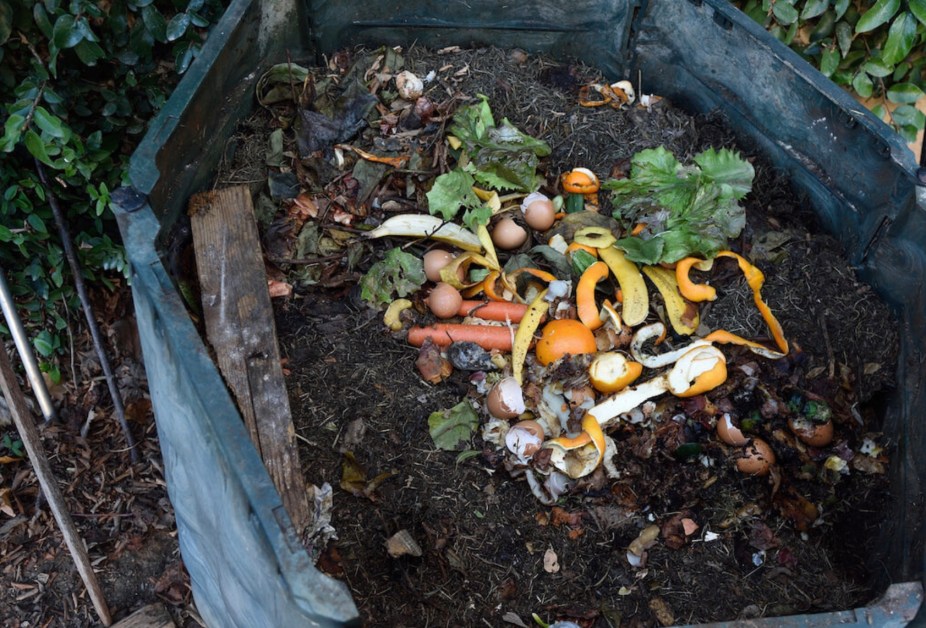
Perhaps I’m a bit weird. I love composting. I’ve never subscribed to the normal rules of composting, the layers of garden refuse, vegetable scraps, dry material and whatever else people suggest should be added in a particular order. I take a much more random approach, throw everything that once was vegetation into the heap in whichever order you come by them, all in together. Water if it’s dry, add shredded newspaper if it’s to wet, and add a bag of chook poo which seems to get it all breaking down. Turn it over whenever you feel like it, and take out anything to mulch the garden with that looks like it’s sufficiently broken down and loamy.
I’ve always just had the one heap perpetually going, adding to it, and taken from it on a weekly basis. It’s fascinating to see vegetable peelings, weeds, and spent plants turning from recognisable scraps into beautiful, sweet smelling loamy soil. I found out long ago that it’s best to look after the soil, and let the soil look after the plants.
Recently we’ve done away with our compost heap. Instead I’m trialling trenching. I save some of my vegetable scraps, but none with seeds – no pumpkin seeds, and definitely no cucumber or tomato seeds. When I have enough I give it all a quick blitz in the blender with some water. It looks like soup. Then I use the trowel to scratch A trench somewhere in the garden and pour in the compost soup, then scratch the soil back over the top.
I’ve only been doing this for a week or two. Hopefully it’ll bring the worms and help the soil along. Time will tell – I’ll let you know how it goes.