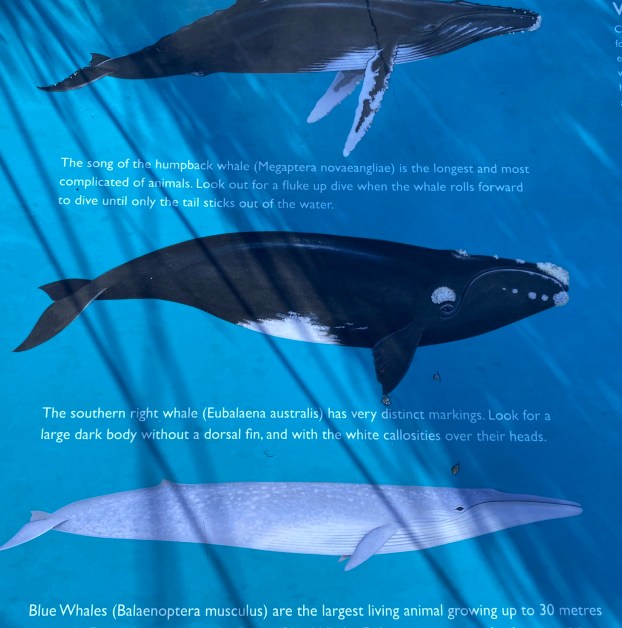
December until April is feeding time for whales in Antartica, however, when breeding time comes they must leave for warmer waters. Their young, born with only a thin coating of blubber, wouldn’t survive the first few months of their lives in the freezing waters, so the parents travel up towards the Equator to give birth. The adult whales don’t feed again until they return to their feeding grounds in November, losing an estimated 25 – 50% of their body weight between their last meal in April, and their next meal seven to eight months later.
By June their babies are born, and they can be seen heading back down the coastline of Australia. Whilst the mums don’t feed at all for approximately seven months, they frequently stop close to shore to rest, and to feed their calves who need to develop some insulating blubber before they reach the krill rich, icy waters of Antartica.
By the time they’re passing the bays close to where we live, the adults are feeding their young and resting as much as possible before they leave the protected waters close to Australia’s shoreline and head into the open waters which will take them to Antartica. Whale watching is now a big industry with whale watching cruises taking thousands of people out each season to get an up close sighting of these fascinating ocean mammals. Being a local though, we know the bays where, on a good day, its possible to see dozens of whales only a few metres off shore, with no boat required. From September to November we often head up to the bays between Dunsborough and Cape Naturalist for a chance encounter of seeing some up really close. Some days we’re lucky, some days we’re not.
Sunday we put on on our walking boots, packed a picnic lunch and headed towards the Cape. First stop was Point Picquet, which is a consistently good spot for close whale encounters. It’s so good in fact, that there’s usually volunteers there from daylight to dusk recording all the whale sightings. The volunteer on duty when we arrived advised us we’d just missed a Blue going by, and that three Blues had been past that morning. Damn – we never seem to be there at the right time to see a Blue. He showed us a photo – it was HUGE! We waited around for a few minutes. A few humpbacks were out towards the horizon, to far away though to get a good view.
Continue reading












 Life of Riley - on whatever